For teams in Ukraine · Kyiv studio and online
Profession-focused German and French training for teams in Ukraine. Each module opens with a real task: a supplier delay call, a price pushback, a project update to a client in Munich or Lyon. Grammar and vocabulary arrive in service of that task, not before it.
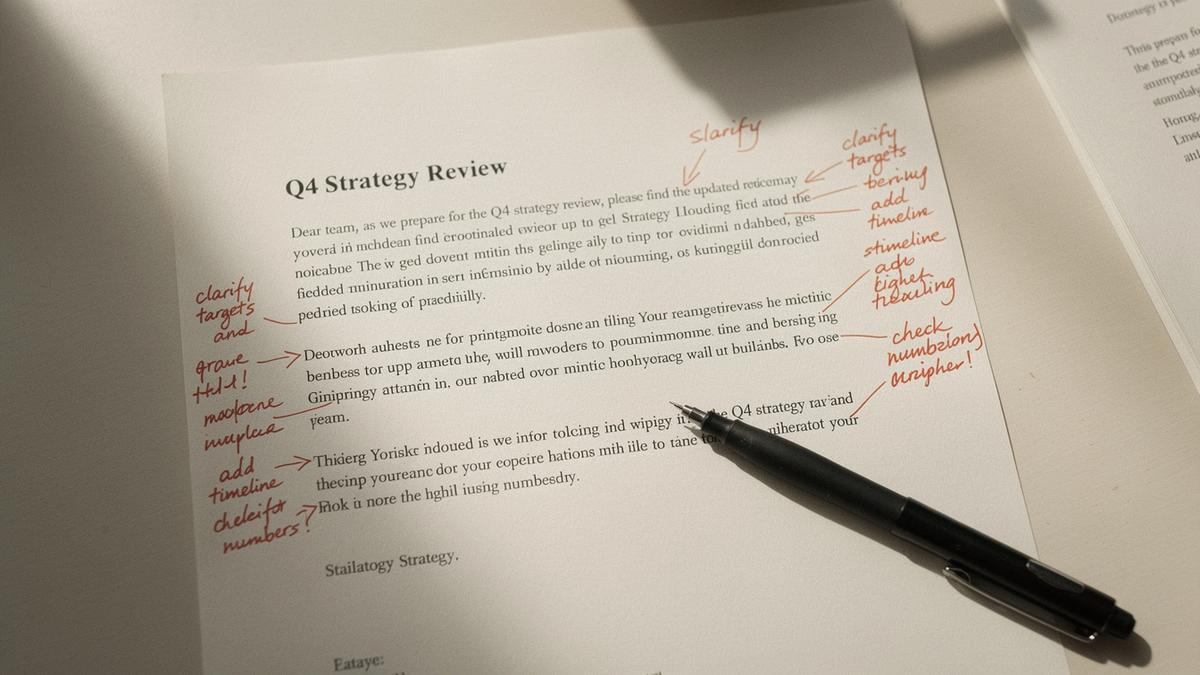
A learner's message to a German supplier, returned the way our trainers mark it: line by line, with the workplace reason attached to every change.
Sehr geehrte Frau Krause,
The formal opening is right for a first written contact in a commercial dispute, so the note says keep it.
Wir haben ein Problem mit der Lieferung.
"Bei der Lieferung vom 4. März ist eine Abweichung aufgetreten." Naming the shipment date and the deviation lets the supplier check stock instead of defending itself.
Bitte antworten Sie schnell.
"Könnten Sie uns bis Freitag bestätigen, ob die restlichen 40 Einheiten am 12. März ankommen?" One deadline, one answerable question.
Mit freundlichen Grüßen
The close stays formal. We add the order reference 43-118 underneath so the thread survives being forwarded to a warehouse team.
Every German or French module is built against the CEFR descriptors that match the tasks your team actually handles. We use them to sequence modules, set feedback criteria and report progress in writing. They are a planning reference, not an examination result and not official certification.
| Level | Can do at work | Tasks we plan for |
|---|---|---|
| A1 | Introduces themselves and handles short routine exchanges with support. | Greet a visitor, spell a surname, confirm a meeting time. |
| A2 | Manages predictable work exchanges on familiar topics. | Book a delivery slot, write a three-line status email. |
| B1 | Follows the main points of a routine call and explains a delay. | Handle a supplier delay call, give a short project update. |
| B2 | Argues a position in a meeting and negotiates with some repair. | Present a proposal, renegotiate a deadline, question a price. |
| C1 | Adapts register and handles unfamiliar, complex negotiation. | Lead a contract discussion, chair a cross-border review. |
Where a role needs a formal certificate, we say so in the scope note and point to an examination body. Our modules prepare the workplace task, not the certificate.
Every trainer on our roster has handled commercial work in a German or French speaking team. They know how a supplier delay call actually opens, which slide a finance director reads first, and why a hedged refusal often works better than a fluent but blunt one.
That business context changes what feedback looks like. We do not mark exercises. We mark the task your team will really send: the email, the status update, the negotiation note.
Feedback starts with the reader. What does the client, buyer or manager need from this message, and where does the draft make them work too hard?
Each weak line is paired with a professional alternative, so the change is visible rather than described. Register, hedging and collocation are named out loud.
Recurring gaps become scenario drills in the following module, with the CEFR descriptor recorded on the plan so managers can see what moved.
Every module runs on the same rhythm. Group size, the clock and the Kyiv studio door are known before you commit.
Book placement interview| Format | Group | Cadence | Runs for | Built for |
|---|---|---|---|---|
| Individual | 1 | 2 x 90 min | 12 weeks | Interview panels, client presentations |
| Pair | 2 | 2 x 90 min | 12 weeks | Two colleagues with one shared deadline |
| Team | 3-6 | 2 x 90 min | 12 weeks | Supplier calls, internal reporting |
| Intensive | 3-6 | 4 x 90 min | 1 week | Launch or relocation window |
German and French groups are scheduled separately, with the same group cap and module length.
Twenty minutes by phone or video. We ask what you already handle in German or French at work, listen to you describe one real task, and propose a starting point with a written scope.
Starting fees are published. The final quote follows the level check.
Role, team size, target language, and the meetings or documents that cause friction.
A short spoken task and a written sample, mapped to CEFR descriptors as planning reference.
Scenario list, module length, and schedule confirmed in writing before the first session.